

January 2026
What’s Next for Latin America?
Region: Latin America
Author: Julieta Gomez
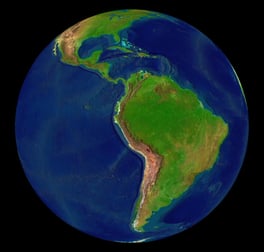
In this evolving and increasingly transactional environment, Latin America finds itself at a strategic crossroads. With general elections scheduled in Brazil, Colombia, Costa Rica, and Peru in 2026, the region’s political leadership will be forced to make consequential choices about alignment, economic openness, and foreign policy posture.
In an unexpected turn of events, the World Economic Forum—long viewed as increasingly detached from tangible geopolitical outcomes—reasserted its relevance this year. European leaders used the global stage to push back forcefully against Washington, while President Trump delivered a headline-grabbing address in which he walked back threats to invade Greenland and impose tariffs on European countries that challenged U.S. policy. The moment underscored a deeper reality: the global order is shifting rapidly, and predictability is no longer the norm.
In this evolving and increasingly transactional environment, Latin America finds itself at a strategic crossroads. With general elections scheduled in Brazil, Colombia, Costa Rica, and Peru in 2026, the region’s political leadership will be forced to make consequential choices about alignment, economic openness, and foreign policy posture. Governments will have to decide whether to acquiesce to external pressure from major powers or pursue more creative strategies—deepening trade and investment ties with like-minded partners while asserting greater strategic autonomy.
The economic backdrop complicates these decisions. According to multilateral estimates, regional growth in Latin America and the Caribbean has hovered around 2 percent in recent years—well below the global average and insufficient to meaningfully reduce poverty or inequality. Several economies remain heavily dependent on a narrow set of revenue streams: hydrocarbons in Mexico, Brazil, and Colombia; commodities and minerals in Chile and Peru; tourism and services in the Caribbean and Central America. At the same time, public debt levels across the region average close to 70 percent of GDP, limiting fiscal space just as global financial conditions tighten.
Concerns about a broader global economic slowdown—or even recession—will inevitably be felt acutely in Latin America. Declining demand from China, volatile energy prices, and uncertainty around U.S. trade policy all pose material risks. Absent diversification, the burden of any downturn will once again fall disproportionately on the most vulnerable populations, exacerbating social tensions that have already fueled political instability in recent years.
Yet Latin America’s structural advantages remain undeniable. The region holds an estimated 60 percent of the world’s lithium reserves, roughly one-third of global freshwater resources, vast arable land, and unparalleled biodiversity. It is uniquely positioned to benefit from nearshoring trends, the energy transition, and growing global demand for critical minerals and sustainable agriculture. What has been missing is coordination. The failure to consolidate a cohesive regional bloc—combined with persistent inequality, weak institutions, and corruption—has consistently undercut the region’s ability to translate assets into influence.
The question, then, is whether 2026 becomes a turning point. Will electoral cycles produce leaders willing to prioritize regional integration, institutional reform, and long-term competitiveness over short-term political gain? Will Latin America finally align its economic potential with strategic vision?
Latin America could be a global leader. The resources are there. The opportunity is there. Whether leaders figure it out in 2026 remains to be seen.