

March 2026
USMCA at a Crossroads: Withdrawal or Renewal?
Region: Latin America
Author: Nadyme Reyes
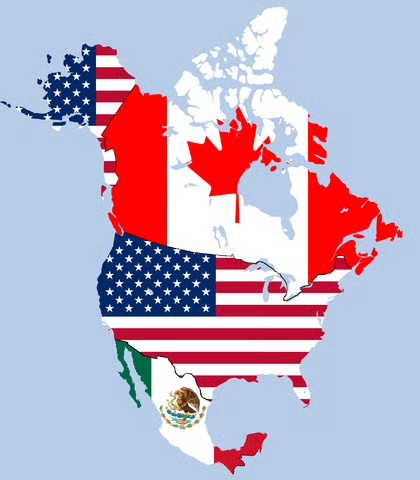
The future of the United States-Mexico-Canada Agreement (USMCA) has been marked by growing speculation and uncertainty amid U.S. tariffs, political tensions among its members, and ongoing disagreements over key chapters of the agreement.
The future of the United States-Mexico-Canada Agreement (USMCA) has been marked by growing speculation and uncertainty amid U.S. tariffs, political tensions among its members, and ongoing disagreements over key chapters of the agreement. Both the United States and some Canadian provinces have proposed negotiating two bilateral agreements rather than the current trilateral treaty, raising doubts about its continuation and the outcome of the USMCA Joint Review, which is expected to conclude in July 2026.
Politically, President Trump’s references to Canada as the United States’ 51st state and Canada’s trade negotiations with China have triggered tensions in a bilateral relationship that years ago seemed unbreakable. At the 2026 Davos Forum, Canadian Prime Minister Mark Carney declared that the era of American world leadership has ended, while President Trump has posted images on social media depicting Canada’s territory covered in the American flag. With Mexico, President Trump has claimed that cartels run Mexico, while the Mexican president, Claudia Sheinbaum, has urged the US to stop supplying cartels with illegal weapons.
Economically, the United States has imposed tariffs on Mexican and Canadian goods based on national security claims, undermining trade certainty and disrupting North America’s economic model in place since 1994. Canada and Mexico faced tariffs on passenger vehicles and light trucks (25%), steel (25%), and aluminum (10%), and non-USMCA goods (25% for Mexico and 35% for Canada). In response, Canada imposed 25% counter-tariffs on American imports, including agricultural products, steel and aluminum goods, clothing, footwear, and other items. Following the US Supreme Court ruling on February 20, 2026, reciprocal and emergency-based tariffs under the International Emergency Economic Powers Act (IEEPA) were invalidated, while measures under Section 232 of the Trade Expansion Act of 1962—including those on steel and aluminum—remain in place.
Yet, beyond these political disagreements and tariff measures, the private sector across all three countries remains clear about the importance of the USMCA for maintaining foreign direct investment, employment, productivity, and North America’s competitiveness. The USMCA is the world’s most significant trade partnership in terms of the total size of its economies, trade flows, and supply chain integration. Combined, the United States, Canada, and Mexico account for nearly 30% of global GDP, almost twice the European Union’s share (16%). USMCA represents a market of 500 million people and a regional trade of almost US$2 trillion annually, supported by a trilateral co-production model that strengthens the region’s competitive advantages.
Mexico and Canada are the United States’ top trading partners, which buy 30% of U.S. goods exports, worth US$600 billion annually. They are also its most strategic partners in the broader economic competition with China. In the last two years, Mexico has imposed 35% tariffs on Chinese goods and 50% on vehicles to discourage the transshipment of non-USMCA goods into the U.S. market.
In that context, business associations and private sector representatives have been actively advocating for the continuation of the USMCA. Industry leaders from Mexico and Canada, including the Business Coordinating Council and the Canadian Chamber of Commerce, have organized missions to the U.S. and issued joint statements underscoring the agreement’s economic benefits and urging governments to extend the trilateral partnership. Similarly, in the United States the National Association of Manufacturers and the Business Roundtable strongly support USMCA as they heavily rely on North American supply chains and continuously work with the government to preserve and deepen integration.
Just as the diplomatic relationship between the three countries is not perfect, the USMCA is not without imperfections, and none of the three members has ever claimed otherwise. However, the USMC is central to the three countries’ economies and supports about 17 million jobs across North America. For the private sector, which implements the agreement, the USMCA has been a success, and the question is not whether it will continue, but how to improve it, furthering integration and addressing key provisions on labor, rules of origin, subsidies, state-owned entities, and dispute resolution. As a result, business leaders will keep advising government decisions ahead of the Joint review on July 1, 2026, which is expected to reinforce North America’s economic integration.